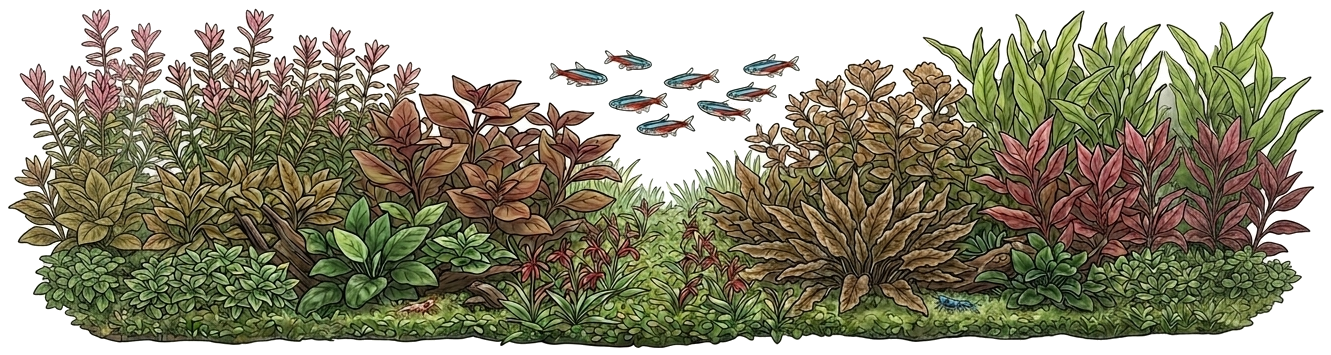
125-Gallon High-Tech Dutch Aquascape (Advanced)
A 125-gallon Dutch aquascape — no rock, no wood, and all of the structure carried by terraced rows of contrasting plants. It is a large display tank, wide enough that the layout has to work across the whole span. Pressurised CO2, active soil and real light — faster growth, more colour, and a tank that needs you every week. 10 plant species, and 4 livestock groups checked against each other for compatibility — every quantity below sized to 125 gallons and every plant chosen for an advanced.
Generate this exact design in the studio →
More than a design — your whole aquarium, handled
Everything below is generated for this 125-gallon Dutch build — 10 plants, 4 livestock groups, and gear sized to 125 gallons. The studio does the same for your tank, free.
Layout — a Dutch tank has no hardscape
The Dutch convention worth borrowing is the street: a diagonal open lane running from the front glass back into the planting, which gives the tank depth without a single rock. Keep groups to odd numbers and never repeat the same species on both sides.Substrate
Aqua soil (e.g. ADA Amazonia / UNS Controsoil), built to about 3–4" and sloped higher at the back. Active soil buffers soft, slightly acidic water and feeds roots. Slope higher at the back for depth.
Fresh aqua soil leaches ammonia for the first one to three weeks. That is normal and it is also why you do not stock a high-tech tank early: run it, change a good volume of water two or three times in that first fortnight, and wait for ammonia and nitrite to read zero before any livestock goes in.
Because this plan carpets the foreground, keep the front of the substrate shallow and level — around an inch is plenty — and save the depth for the back. Carpets are planted into a flat bed in small clumps a couple of centimetres apart, and they spread sideways to meet; planting them dense enough to look finished on day one wastes plants and traps debris.
At 125 gallons the substrate is a real purchase, not an afterthought — budget for it early and buy it all at once, because a bed topped up later with a different bag rarely matches.
Plant list & placement
Plant back to front, into damp substrate with the tank only part-filled — it is far easier than fighting buoyancy in a full tank. Red Stem Knotweed is the tallest thing in this plan at around 20", so it sets your back row and everything else steps down in front of it.
Red Stem Knotweed is the fast grower here — unusual stem plant with small oval leaves turning attractive bronze-red under high light with CO2. Less commonly available. Striking colour contrast in Dutch layouts. Expect to be cutting it weekly once it establishes. Top the stems, replant the healthy tops in the same group and discard the old bases; a stem bed replanted from tops stays dense, while one left to grow on goes bare at the bottom.
Group the stems rather than spacing them out. Needle Ludwigia, Red Stem Knotweed and Limnophila aromatica each want to be planted as a block of stems an inch or so apart, cut to slightly different heights so the group fills in with a rounded top instead of a flat hedge.
Broadleaf Eusteralis is the demanding species in this plan, which is why it appears at advanced level: it needs stable CO2, consistent dosing and real light, and will show you the moment any of the three slips.
Stocking
This stocking is built to spread through the tank rather than crowd one layer: Coral Red Pencilfish and Black Neon Tetra share the open middle water and German Blue Ram and Bronze Cory share the floor. A tank where every fish occupies the same band looks half-empty even when it is fully stocked, and the fish themselves compete more.
Keep Coral Red Pencilfish in 6 or more, Bronze Cory in 6 or more and Black Neon Tetra in 6 or more. These are not decorative numbers — a shoaling fish kept in threes spends its life stressed, colours down and hides, and people then conclude the species is dull. The counts in the list above are already scaled to this tank.
German Blue Ram is the centrepiece. Gentle dwarf cichlid needing warm, soft, very clean water; sensitive.
- Coral Red Pencilfish — Keep Coral Red Pencilfish in a group of at least 6 — kept in ones or twos they get stressed, shy, and nippy.
- German Blue Ram — German Blue Ram is territorial/solitary — best kept as a single specimen.
- Bronze Cory — Keep Bronze Cory in a group of at least 6 — kept in ones or twos they get stressed, shy, and nippy.
- Black Neon Tetra — Keep Black Neon Tetra in a group of at least 6 — kept in ones or twos they get stressed, shy, and nippy.
These species are close enough in size and temperament that none of them out-competes another at feeding time, which is the quiet reason a lot of communities fail. Every pairing was run through Skapelab’s compatibility engine and anything returning even a caution was swapped out rather than published. Check any substitution you make there before you buy.
Equipment
| Category | Recommendation | Notes |
|---|---|---|
| Filtration | Eheim Professionel 4+ 600 | ~$380–470 |
| Lighting | Twinstar 1200SP | ~$720–860 |
| Co2 | GreenLeaf Aquarium GLA Regulator + 20lb Cylinder | ~$400–510 |
| Heating | Oase BioMaster Thermo 600 (integrated) | Included with Oase BioMaster Thermo 600 (~$360–450) |
| Fertilizer | Estimative Index DIY NPK Dry Ferts Kit | ~$28–45 |
| Testkit | API Freshwater Master Test Kit | ~$28–42 |
| Water treatment | Seachem Prime 500ml | ~$12–20 |
| Bacteria | Seachem Stability 250ml | ~$8–14 |
What the first two months look like
| Week 1 | Substrate contoured, rows planted, filled and running with no livestock — nothing to place first here, so the planting IS the layout and it is worth taking time over. CO2 comes on an hour before the lights and off an hour before they go out; aim the drop checker at a green, never yellow. Keep the photoperiod short, around six hours, while the plants root. |
| Weeks 2–4 | Cycling, and the ugly phase. Brown diatom dust on the glass and hardscape is normal in a new tank and passes on its own once silicates are used up; the fresh soil is also still releasing ammonia, so keep changing water. Some plants will melt back and regrow in their submersed form — that is conversion, not death, so trim the mush and leave the roots. Do not stock until ammonia and nitrite both read zero. |
| Weeks 4–6 | Stocking begins, a few animals at a time with a fortnight and a water test between additions. First topping of the stem groups — cut, replant the tops, and the rows begin to read as rows. |
| Months 2–3 | The scape fills in and the routine settles into the schedule below. On a tank this size, get the maintenance rhythm fixed now — a large tank is very stable until it is not, and by then it is a large problem. |
Care schedule
| Daily | Feed lightly — as much as they clear in a minute or two — and take ten seconds to count heads and look at the plants. Check the drop checker is green before the lights come on. |
| Weekly | 40% water change — about 50 gallons on this tank — using a tap-fed water changer — at this volume buckets stop being realistic. Dose your macros and micros after the change, not before. Wipe the glass and check the CO2 cylinder pressure. |
| Monthly | Rinse filter media in old tank water — never under the tap, which kills the bacteria colony you spent six weeks growing. Test KH, GH, pH and nitrate. On a tank this size also check the seals and the stand for damp, because a slow leak here is a floor problem, not a tank problem. |
| Every few months | Replace the CO2 diffuser membrane, check the regulator has not crept, and pull the deepest stems for a hard replant. Lights lose output long before they fail — plan on replacing LEDs or bulbs on a schedule, not on symptoms. |
Make it yours
This is a starting point. Open it in the studio to swap plants, resize to your tank, and get a hand-illustrated render, placement diagram, and shopping list — free.
Start this build →