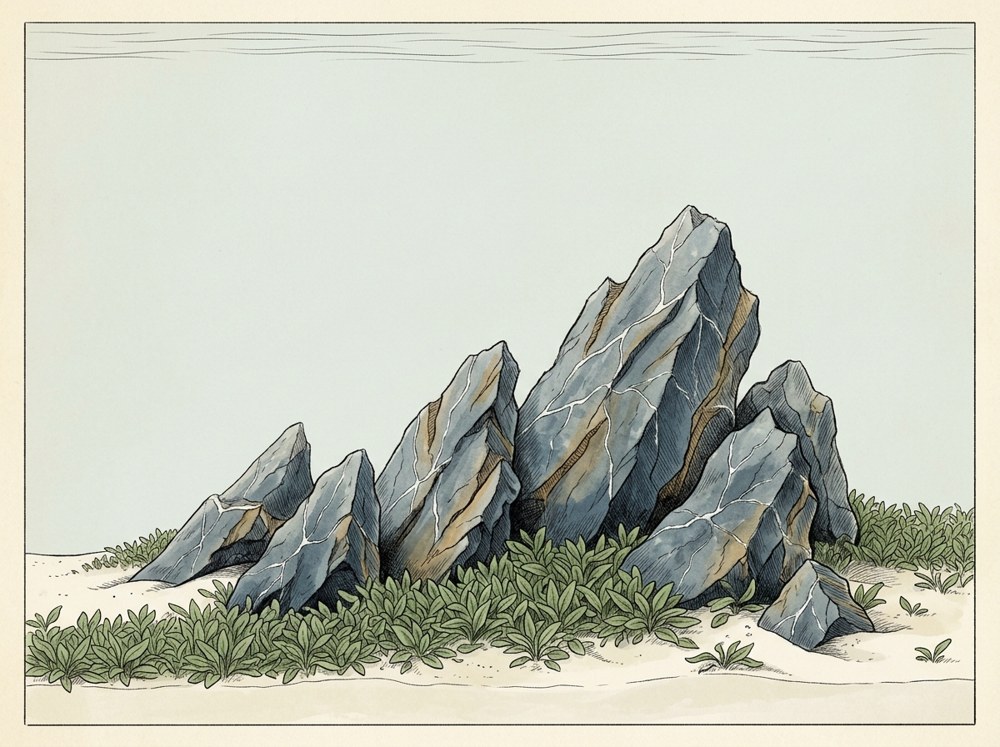
40-Gallon Low-Tech Iwagumi Aquascape (Beginner)
A 40-gallon breeder Iwagumi: a few stones, one carpet, and a great deal of deliberate empty water. It is a standard tank size, and the easiest bracket to get right. No CO2 and no dosing regime — slower to fill in, far more forgiving, and cheaper to run. 1 plant species, Dragon Stone, and 4 livestock groups checked against each other for compatibility — every quantity below sized to 40 gallons and every plant chosen for a beginner.
Generate this exact design in the studio →
More than a design — your whole aquarium, handled
Everything below is generated for this 40-gallon breeder Iwagumi build — 1 plant, 4 livestock groups, and gear sized to 40 gallons. The studio does the same for your tank, free.
Hardscape — what to buy and how to place it
Dragon Stone is warm ochre and deeply pitted, full of hollows and honeycombed pockets. Dragon Stone is baked clay and chemically inert, so it will not move your pH or hardness in either direction. Rinse and scrub it hard before it goes in — dry Ohko sheds a fine clay dust that will cloud the water for days. The hollows are planting pockets: press moss or a small epiphyte into them and the stone disappears into the scape as it grows.
At 40 gallons, plan on five to seven pieces in clearly unequal sizes. An odd count is easier to compose, and one piece should obviously lead — a group of similar-sized pieces spread evenly across the tank is the most common way a first scape goes flat.
Iwagumi is built from named roles, not from a pile. The Oyaishi is the main stone: the largest, set on a third of the tank width rather than the centre, leaning very slightly off vertical. The Fukuishi supports it from the opposite side at roughly two-thirds its size, and the Soeishi is smaller again and sits close to the Oyaishi. Odd numbers only, and no two stones the same size.
Substrate
Aqua soil or capped organic base, capped with fine natural gravel/sand cap, built to about 2.5–3.5" and sloped higher at the back. A nutrient base keeps low-tech plants fed; cap with fine gravel. Slope higher at the back.
A capped nutrient base is the engine of a low-tech tank, so the one rule is to leave it alone. Vacuum the cap, never the layer beneath it — driving a siphon down into the base releases everything it has been quietly storing and can gas a tank in an afternoon.
The whole floor of this tank is Marsilea crenata, so the substrate contour IS the layout — there is no background planting to hide a flat bed. Build a real slope from front to back and let the carpet run up and over it; that rise is what gives an otherwise open tank its depth. Plant in small clumps a couple of centimetres apart and let them spread sideways to meet, rather than packing them in to look finished on day one.
Plant list & placement
Plant back to front, into damp substrate with the tank only part-filled — it is far easier than fighting buoyancy in a full tank. Marsilea crenata is the tallest thing in this plan at around 2", so it sets your back row and everything else steps down in front of it.
Nothing in this plan grows quickly, which is the point — it means very little trimming, but it also means the tank takes longer to look established and gives algae a wider opening in the first two months. Keep the light modest until the plants are visibly growing.
Every plant here is a hardy, forgiving species. None of them need CO2 to survive, and all of them recover from being neglected for a fortnight — which is the right way to start, because the tank should be teaching you the routine rather than punishing you for missing it.
Stocking
This stocking is built to spread through the tank rather than crowd one layer: Gold Ring Danio works the open middle water, Dwarf Gourami works the surface and Black Kuhli Loach works the floor. A tank where every fish occupies the same band looks half-empty even when it is fully stocked, and the fish themselves compete more.
Keep Gold Ring Danio in 8 or more and Black Kuhli Loach in 5 or more. These are not decorative numbers — a shoaling fish kept in threes spends its life stressed, colours down and hides, and people then conclude the species is dull. The counts in the list above are already scaled to this tank.
Dwarf Gourami is the centrepiece. Colorful peaceful centerpiece; one male per small tank to avoid squabbles.
Red Racer Nerite Snail is the clean-up crew, and in a planted tank it earns its place — grazing biofilm and soft algae off the hardscape and leaves faster than you can. Add it last, once the tank has some algae to eat, and drip-acclimatise rather than dumping the bag in.
- Gold Ring Danio — Keep Gold Ring Danio in a group of at least 8 — kept in ones or twos they get stressed, shy, and nippy.
- Dwarf Gourami — Dwarf Gourami is territorial/solitary — best kept as a single specimen.
- Black Kuhli Loach — Keep Black Kuhli Loach in a group of at least 5 — kept in ones or twos they get stressed, shy, and nippy.
The largest fish here is roughly 2.9× the length of the smallest, which is the point at which size alone starts to matter — that gap was checked against mouth size and feeding behaviour, not just temperament. Every pairing was run through Skapelab’s compatibility engine and anything returning even a caution was swapped out rather than published. Check any substitution you make there before you buy.
Equipment
| Category | Recommendation | Notes |
|---|---|---|
| Filtration | Aquaclear 50 Power Filter (HOB) | ~$45–62 |
| Lighting | Fluval Aquasky 2.0 36–48" | ~$78–108 |
| Heating | Eheim Jager 100W | ~$27–38 |
| Substrate | Fluval Stratum 17.6lb | ~$48–65 |
| Fertilizer | Seachem Flourish Comprehensive 250ml | ~$8–14 |
| Testkit | API Freshwater Master Test Kit | ~$28–42 |
| Water treatment | Seachem Prime 500ml | ~$12–20 |
| Bacteria | Seachem Stability 250ml | ~$8–14 |
What the first two months look like
| Week 1 | Hardscape in, planted, filled and running with no livestock. Start the photoperiod short — six hours is plenty — because the plants are not yet growing fast enough to use more, and the surplus goes to algae. |
| Weeks 2–4 | Cycling, and the ugly phase. Brown diatom dust on the glass and hardscape is normal in a new tank and passes on its own once silicates are used up. Some plants will melt back and regrow in their submersed form — that is conversion, not death, so trim the mush and leave the roots. Do not stock until ammonia and nitrite both read zero. |
| Weeks 4–6 | Stocking begins, a few animals at a time with a fortnight and a water test between additions. The carpet should be visibly running now; resist raising the light to hurry it. |
| Months 2–3 | The scape fills in and the routine settles into the schedule below. Judge the design now rather than on day one; a planted tank is not finished until it has grown into itself. |
Care schedule
| Daily | Feed lightly — as much as they clear in a minute or two — and take ten seconds to count heads and look at the plants. |
| Weekly | 27% water change — about 11 gallons — using a siphon and a bucket. Wipe the glass, vacuum the open substrate only, and dose a light all-in-one fertiliser. Trimming is occasional rather than weekly at this growth rate. |
| Monthly | Rinse filter media in old tank water — never under the tap, which kills the bacteria colony you spent six weeks growing. Test KH, GH, pH and nitrate. Check for anything the weekly routine keeps missing behind the hardscape. |
| Every few months | Thin the slow growers back hard once or twice a year, divide anything that has outgrown its spot, and top up root tabs around the heavy feeders. |
Make it yours
This is a starting point. Open it in the studio to swap plants, resize to your tank, and get a hand-illustrated render, placement diagram, and shopping list — free.
Start this build →