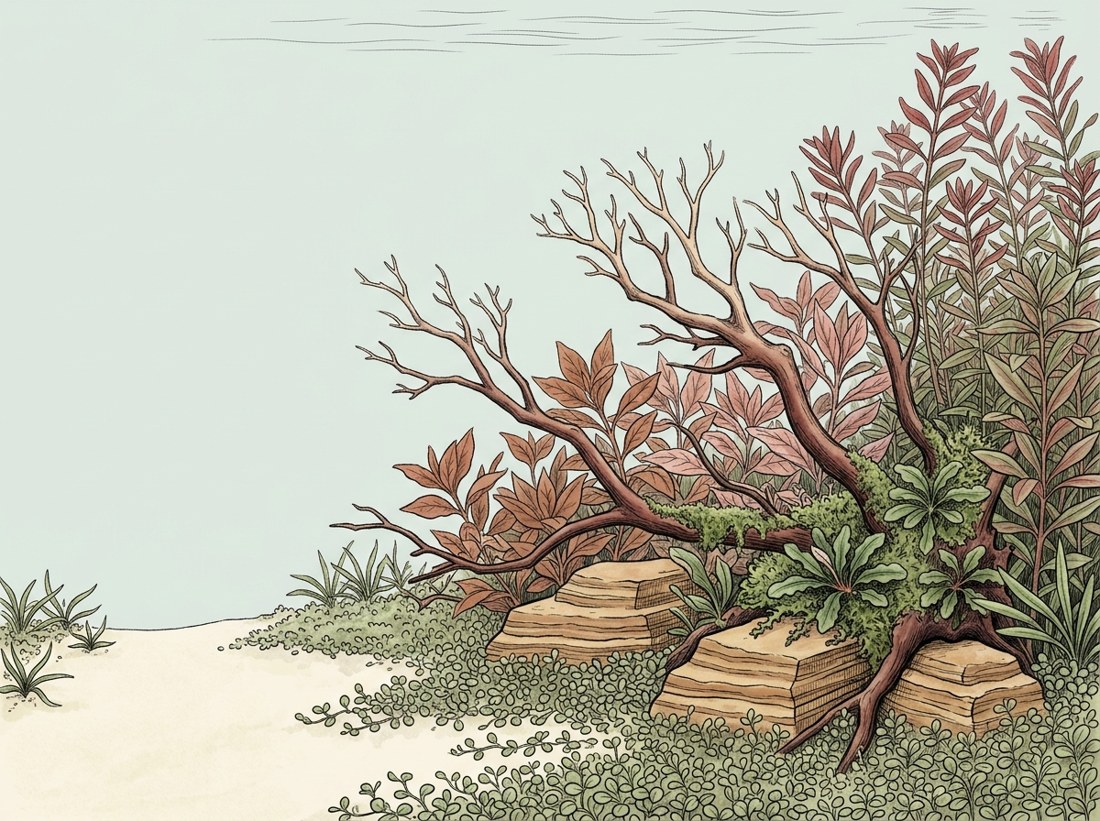
5-Gallon High-Tech Nature Aquascape (Intermediate)
A 5-gallon nano Nature Aquarium — a landscape rather than a display, built around one off-centre focal mass with the planting stepping away from it. It is a nano tank, where every decision shows. Pressurised CO2, active soil and real light — faster growth, more colour, and a tank that needs you every week. 6 plant species, Manzanita Wood and Pagoda Stone, and 2 livestock groups checked against each other for compatibility — every quantity below sized to 5 gallons and every plant chosen for an intermediate.
Generate this exact design in the studio →
More than a design — your whole aquarium, handled
Everything below is generated for this 5-gallon nano Nature build — 6 plants, 2 livestock groups, and gear sized to 5 gallons. The studio does the same for your tank, free.
Hardscape — what to buy and how to place it
Manzanita Wood is pale, hard and finely branched, dividing again and again into thin twig ends. Manzanita releases only light tannins, so the water stays clear rather than going the colour of tea. It floats, and it will keep floating for two to six weeks. Either boil it, or weight it down with a stone until it waterlogs — this is the most common first-week surprise with manzanita. A thin white biofilm on the fresh wood is normal and passes on its own.
Pagoda Stone is flat horizontal strata stacked like a pile of plates, in warm tan and grey. Pagoda carries some calcium carbonate, so expect a mild lift in hardness rather than a dramatic one. Its whole character is the layering, so set the strata level and let the pieces step rather than tilt — a pagoda stone stood on end stops looking like pagoda stone.
Pairing Manzanita Wood with Pagoda Stone works because they do different jobs: the stone anchors the base and holds your substrate contour, and the wood carries the height and the movement above it. Let them touch — wood resting into a stone, sand banked against both — so the two read as one structure rather than two separate features sharing a tank.
Depth here is created by overlap, not by shrinking things in the distance. Set your pieces at different distances from the front glass so a nearer one partly covers a further one; two overlapping masses read as a landscape, while the same two side by side read as objects on a shelf.
Substrate
Aqua soil (e.g. ADA Amazonia / UNS Controsoil), built to about 2–3" and sloped higher at the back. Active soil buffers soft, slightly acidic water and feeds roots. Slope higher at the back for depth.
Fresh aqua soil leaches ammonia for the first one to three weeks. That is normal and it is also why you do not stock a high-tech tank early: run it, change a good volume of water two or three times in that first fortnight, and wait for ammonia and nitrite to read zero before any livestock goes in.
Because this plan carpets the foreground, keep the front of the substrate shallow and level — around an inch is plenty — and save the depth for the back. Carpets are planted into a flat bed in small clumps a couple of centimetres apart, and they spread sideways to meet; planting them dense enough to look finished on day one wastes plants and traps debris.
Plant list & placement
Plant back to front, into damp substrate with the tank only part-filled — it is far easier than fighting buoyancy in a full tank. Red Stem Knotweed is the tallest thing in this plan at around 20", so it sets your back row and everything else steps down in front of it.
Red Stem Knotweed is the fast grower here — unusual stem plant with small oval leaves turning attractive bronze-red under high light with CO2. Less commonly available. Striking colour contrast in Dutch layouts. Expect to be cutting it weekly once it establishes. Top the stems, replant the healthy tops in the same group and discard the old bases; a stem bed replanted from tops stays dense, while one left to grow on goes bare at the bottom.
Bucephalandra 'Brownie' is an epiphyte and must never be buried. Tie or glue the rhizome onto your hardscape and leave it fully exposed — a buried rhizome rots, and it is the single most common way a beginner loses an Anubias or a Java fern. Only the roots may touch the substrate.
Group the stems rather than spacing them out. Red Stem Knotweed and Limnophila aromatica each want to be planted as a block of stems an inch or so apart, cut to slightly different heights so the group fills in with a rounded top instead of a flat hedge.
Stocking
At 5 gallons this is deliberately a single-group tank — Betta (Siamese Fighting Fish) works every level. One species kept properly in numbers is a better-looking tank than three species kept in twos, and in a tank this size it is also the only honest option.
Betta (Siamese Fighting Fish) is the centrepiece, and being semi-aggressive it sets the limit on what else can go in. Solo centerpiece; never house two males. Calm tankmates only, no fin-nippers.
Zebra Nerite Snail is the clean-up crew, and in a planted tank it earns its place — grazing biofilm and soft algae off the hardscape and leaves faster than you can. Add it last, once the tank has some algae to eat, and drip-acclimatise rather than dumping the bag in.
- Betta (Siamese Fighting Fish) — Keep only ONE male Betta — males fight to the death. One male with several females works only in a large, heavily planted tank.
Betta (Siamese Fighting Fish) has trailing fins, so the real constraint on this tank is fin-nipping — every other species here was tested against that specifically and anything that has been credibly reported as a nipper was excluded, not merely flagged. Every pairing was run through Skapelab’s compatibility engine and anything returning even a caution was swapped out rather than published. Check any substitution you make there before you buy.
Equipment
| Category | Recommendation | Notes |
|---|---|---|
| Filtration | Fluval 107 Canister Filter | ~$88–118 |
| Co2 | AQUATEK Mini CO2 Regulator + 20oz Paintball | ~$65–88 |
| Heating | Fluval E50 Electronic Heater | ~$28–38 |
| Testkit | API Freshwater Master Test Kit | ~$28–42 |
| Water treatment | Seachem Prime 500ml | ~$12–20 |
| Bacteria | Seachem Stability 250ml | ~$8–14 |
What the first two months look like
| Week 1 | Hardscape in, planted, filled and running with no livestock. CO2 comes on an hour before the lights and off an hour before they go out; aim the drop checker at a green, never yellow. Your Manzanita Wood will still be trying to float, so keep it weighted or clipped down until it waterlogs. |
| Weeks 2–4 | Cycling, and the ugly phase. Brown diatom dust on the glass and hardscape is normal in a new tank and passes on its own once silicates are used up; the fresh soil is also still releasing ammonia, so keep changing water. Some plants will melt back and regrow in their submersed form — that is conversion, not death, so trim the mush and leave the roots. Do not stock until ammonia and nitrite both read zero. |
| Weeks 4–6 | Stocking begins, a few animals at a time with a fortnight and a water test between additions. In a tank this small there is no margin — one full stocking list added at once is the classic way a nano crashes. The first real trim happens somewhere in here, and the tank stops looking newly planted. |
| Months 2–3 | The scape fills in and the routine settles into the schedule below. Judge the design now rather than on day one; a planted tank is not finished until it has grown into itself. |
Care schedule
| Daily | Feed lightly — as much as they clear in a minute or two — and take ten seconds to count heads and look at the plants. Check the drop checker is green before the lights come on. |
| Weekly | 40% water change — about 2 gallons on this tank — using a jug and a length of airline. Dose your macros and micros after the change, not before. Wipe the glass and check the CO2 cylinder pressure. |
| Monthly | Rinse filter media in old tank water — never under the tap, which kills the bacteria colony you spent six weeks growing. Test KH, GH, pH and nitrate. Check for anything the weekly routine keeps missing behind the hardscape. |
| Every few months | Replace the CO2 diffuser membrane, check the regulator has not crept, and pull the deepest stems for a hard replant. Lights lose output long before they fail — plan on replacing LEDs or bulbs on a schedule, not on symptoms. |
Make it yours
This is a starting point. Open it in the studio to swap plants, resize to your tank, and get a hand-illustrated render, placement diagram, and shopping list — free.
Start this build →