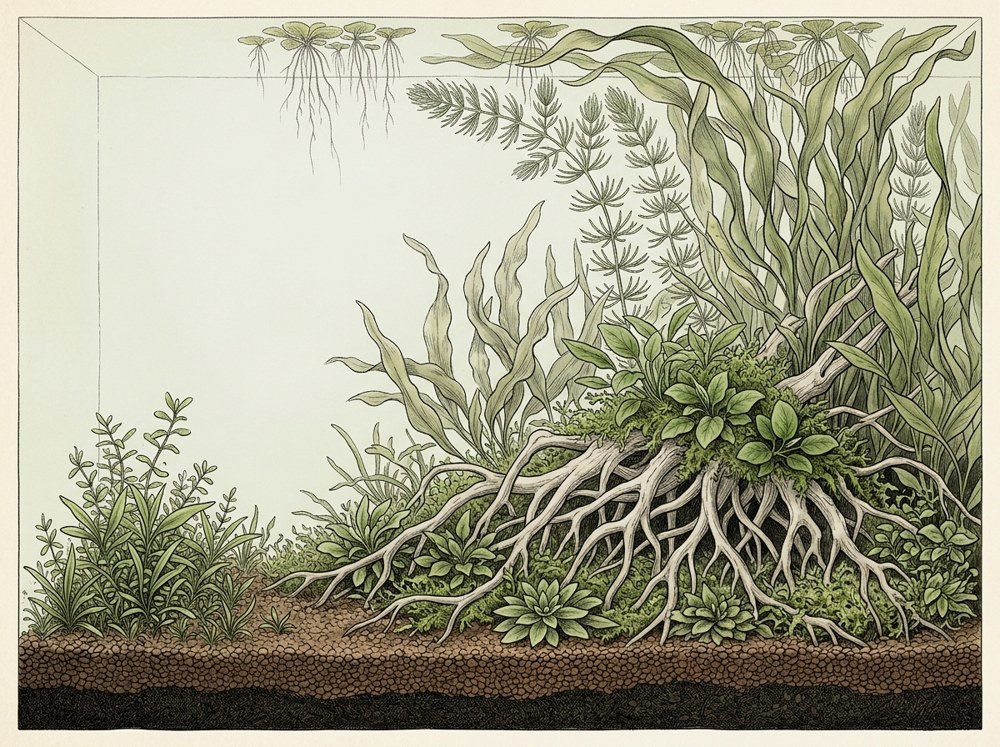
10-Gallon Low-Tech Walstad Aquascape (Beginner)
A 10-gallon Walstad-method tank: a nutrient soil base under a cap, heavy planting, and a system built to look after itself. It is a nano tank, where every decision shows. No CO2 and no dosing regime — slower to fill in, far more forgiving, and cheaper to run. 6 plant species, Petrified Wood, and 2 livestock groups checked against each other for compatibility — every quantity below sized to 10 gallons and every plant chosen for a beginner.
Generate this exact design in the studio →
More than a design — your whole aquarium, handled
Everything below is generated for this 10-gallon Walstad build — 6 plants, 2 livestock groups, and gear sized to 10 gallons. The studio does the same for your tank, free.
Hardscape — what to buy and how to place it
Petrified Wood is fossilised timber — real wood grain and growth rings held in stone, in dense browns and greys. Petrified wood is silica through and through, so it is completely inert. It is heavier than it looks — bed the base into the substrate rather than resting it on top, and put nothing fragile underneath it. Because it reads as both stone and wood, one piece can carry a scape that would otherwise need two materials.
At 10 gallons, plan on three pieces in clearly unequal sizes. An odd count is easier to compose, and one piece should obviously lead — a group of similar-sized pieces spread evenly across the tank is the most common way a first scape goes flat.
A Walstad tank is driven by the soil and the plants, so the hardscape stays deliberately minimal — a piece or two for structure and shade, placed to leave the substrate open where roots want to run.
Substrate
Aqua soil or capped organic base, capped with fine natural gravel/sand cap, built to about 2–3" and sloped higher at the back. A nutrient base keeps low-tech plants fed; cap with fine gravel. Slope higher at the back.
A capped nutrient base is the engine of a low-tech tank, so the one rule is to leave it alone. Vacuum the cap, never the layer beneath it — driving a siphon down into the base releases everything it has been quietly storing and can gas a tank in an afternoon.
Because this plan carpets the foreground, keep the front of the substrate shallow and level — around an inch is plenty — and save the depth for the back. Carpets are planted into a flat bed in small clumps a couple of centimetres apart, and they spread sideways to meet; planting them dense enough to look finished on day one wastes plants and traps debris.
Chain Sword (Belem), Cryptocoryne lutea and Cryptocoryne undulata are root feeders rather than water-column feeders, so they want depth and a root tab more than they want dosing. Give that part of the bed the extra depth.
Plant list & placement
Plant back to front, into damp substrate with the tank only part-filled — it is far easier than fighting buoyancy in a full tank. Aponogeton undulatus is the tallest thing in this plan at around 20", so it sets your back row and everything else steps down in front of it.
Aponogeton undulatus is the fast grower here — one of the most common bulb plants in the hobby, often sold in mass-market bulb kits. Produces long wavy pale green leaves from a corm; very undemanding and grows well in low-tech setups. Goes dormant periodically — remove the corm, let it rest in moist conditions for a few weeks, then replant. Ideal for beginner tanks and Walstad setups. Expect to be cutting it every two or three weeks once it establishes. Top the stems, replant the healthy tops in the same group and discard the old bases; a stem bed replanted from tops stays dense, while one left to grow on goes bare at the bottom.
Lance-leaf Anubias is an epiphyte and must never be buried. Tie or glue the rhizome onto your hardscape and leave it fully exposed — a buried rhizome rots, and it is the single most common way a beginner loses an Anubias or a Java fern. Only the roots may touch the substrate.
Group the stems rather than spacing them out. Aponogeton undulatus and Bacopa caroliniana each want to be planted as a block of stems an inch or so apart, cut to slightly different heights so the group fills in with a rounded top instead of a flat hedge.
Every plant here is a hardy, forgiving species. None of them need CO2 to survive, and all of them recover from being neglected for a fortnight — which is the right way to start, because the tank should be teaching you the routine rather than punishing you for missing it.
Stocking
At 10 gallons this is deliberately a single-group tank — Betta (Siamese Fighting Fish) works every level. One species kept properly in numbers is a better-looking tank than three species kept in twos, and in a tank this size it is also the only honest option.
Betta (Siamese Fighting Fish) is the centrepiece, and being semi-aggressive it sets the limit on what else can go in. Solo centerpiece; never house two males. Calm tankmates only, no fin-nippers.
Red Racer Nerite Snail is the clean-up crew, and in a planted tank it earns its place — grazing biofilm and soft algae off the hardscape and leaves faster than you can. Add it last, once the tank has some algae to eat, and drip-acclimatise rather than dumping the bag in.
- Betta (Siamese Fighting Fish) — Keep only ONE male Betta — males fight to the death. One male with several females works only in a large, heavily planted tank.
Betta (Siamese Fighting Fish) has trailing fins, so the real constraint on this tank is fin-nipping — every other species here was tested against that specifically and anything that has been credibly reported as a nipper was excluded, not merely flagged. Every pairing was run through Skapelab’s compatibility engine and anything returning even a caution was swapped out rather than published. Check any substitution you make there before you buy.
Equipment
| Category | Recommendation | Notes |
|---|---|---|
| Filtration | Aquatop SP-80B Sponge Filter | ~$7–12 |
| Lighting | Fluval Nano Aquasky LED | ~$30–42 |
| Heating | Fluval E50 Electronic Heater | ~$28–38 |
| Substrate | Fluval Stratum Substrate 4.4lb | ~$18–28 |
| Fertilizer | Seachem Flourish Comprehensive 250ml | ~$8–14 |
| Testkit | API Freshwater Master Test Kit | ~$28–42 |
| Water treatment | Seachem Prime 500ml | ~$12–20 |
| Bacteria | Seachem Stability 250ml | ~$8–14 |
What the first two months look like
| Week 1 | Hardscape in, planted, filled and running with no livestock. Start the photoperiod short — six hours is plenty — because the plants are not yet growing fast enough to use more, and the surplus goes to algae. |
| Weeks 2–4 | Cycling, and the ugly phase. Brown diatom dust on the glass and hardscape is normal in a new tank and passes on its own once silicates are used up. Some plants will melt back and regrow in their submersed form — that is conversion, not death, so trim the mush and leave the roots. Do not stock until ammonia and nitrite both read zero. |
| Weeks 4–6 | Stocking begins, a few animals at a time with a fortnight and a water test between additions. In a tank this small there is no margin — one full stocking list added at once is the classic way a nano crashes. The first real trim happens somewhere in here, and the tank stops looking newly planted. |
| Months 2–3 | The soil settles into balance and the tank starts running itself. This is the point where a Walstad tank rewards having been left alone: stable, undemanding, and needing less from you each month rather than more. |
Care schedule
| Daily | Feed lightly — as much as they clear in a minute or two — and take ten seconds to count heads and look at the plants. |
| Weekly | 27% water change — about 3 gallons — using a jug and a length of airline. Wipe the glass, vacuum the open substrate only, and dose a light all-in-one fertiliser. Trimming is occasional rather than weekly at this growth rate. |
| Monthly | Rinse filter media in old tank water — never under the tap, which kills the bacteria colony you spent six weeks growing. Test KH, GH, pH and nitrate. Check for anything the weekly routine keeps missing behind the hardscape. |
| Every few months | Thin the slow growers back hard once or twice a year, divide anything that has outgrown its spot, and top up root tabs around the heavy feeders. |
Make it yours
This is a starting point. Open it in the studio to swap plants, resize to your tank, and get a hand-illustrated render, placement diagram, and shopping list — free.
Start this build →